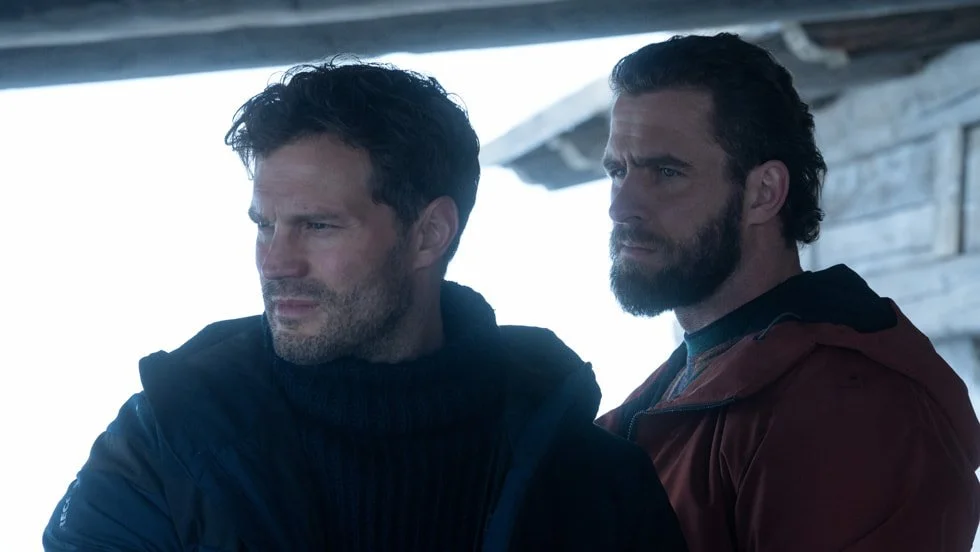
As the Apple TV heist thriller moves deeper into its three-part timeline, professional redemption, personal loyalty, and the consequences of one enormous robbery begin to collide.
In a heist, the smallest detail can become the biggest problem. That is the uncomfortable reality confronting the characters of 12 12 12 as the Apple TV crime thriller returns for its second episode, “I Want My Halo Back.” What began as an elaborate contest between criminal ingenuity and investigative determination becomes something increasingly personal, with Anthony Mackie’s Jack Strickland and Jamie Dornan’s Paul Galvin discovering that the consequences of the robbery extend well beyond the money.
Following a premiere that established the series’ unusual twelve-month, twelve-hour, and twelve-day narrative framework, Episode 2 moves further into the mechanics of an extraordinary operation while examining the pressures that drive its central characters. The result is a chapter less concerned with introducing the game than exploring the motivations of the people who have committed themselves to playing it.
Dornan’s Paul remains an intriguing contradiction. He possesses the technical understanding, patience, and strategic discipline required to contemplate a robbery of extraordinary complexity, yet his personal circumstances continually threaten the control he works so carefully to maintain. His relationship with Séverine, played by Agathe Rousselle, gives those circumstances emotional weight, particularly as the demands of his criminal life begin competing with the responsibilities and security he hopes to establish at home.
The February planning timeline expands the scale of the operation, introducing additional financial considerations, institutional obstacles, and questions about where immense amounts of money can be safely concealed. The series is particularly effective when it treats the bank not simply as a building to be penetrated but as part of a sophisticated financial ecosystem. The architecture, technology, and interests surrounding the money are integral to understanding why such an ambitious undertaking requires months of preparation.
Of course, preparation is only as valuable as the assumptions behind it. The episode returns to the execution timeline with the crew confronting problems that demonstrate how quickly a carefully engineered operation can become vulnerable to unforeseen circumstances. Technical precision remains essential, but the more complicated the undertaking becomes, the more its success depends on individual judgment, trust, and the ability to respond under pressure.
For Mackie’s Jack Strickland, the situation presents a different kind of challenge. His relentless pursuit of the Galvin brothers is shaped by professional ambition and a past that continues to cast a considerable shadow over his career. The title “I Want My Halo Back” speaks directly to questions of reputation, recognition, and the difficulty of rebuilding an identity after a consequential failure.
Mackie gives Jack an appealing mixture of arrogance, intelligence, frustration, and emotional vulnerability. His character’s confidence is rarely in doubt, but the reasons behind that confidence are considerably more complicated. There is a distinction between wanting to solve a case and needing a successful investigation to restore something lost. Episode 2 becomes more interesting as it explores the distance between those motivations.
That personal dimension also complicates the relationship between the pursuer and the pursued. Paul and Jack are not merely operating on opposite sides of the law. They are men whose previous experiences influence how they perceive danger, loyalty, and their own ability to determine what happens next. Each believes that careful calculation can overcome an increasingly unpredictable situation, even as circumstances begin testing that conviction.
The supporting ensemble continues to deepen the story’s emotional stakes. Serge, played by José Garcia, occupies an especially important place within Paul’s personal world, bringing questions of family, trust, and responsibility into a narrative otherwise dominated by criminal strategy. His presence reinforces the idea that the most significant decisions within the operation cannot always be measured in financial terms.
Meanwhile, the relationships among the crew reveal how difficult it is to maintain unity when the stakes are this high. Every participant has a purpose, but shared participation does not necessarily mean shared priorities. The operation requires cooperation from individuals whose motivations, personalities, and tolerance for risk are not always compatible.
The episode’s narrative construction remains one of the series’ defining characteristics. By moving between preparation, execution, and aftermath, 12 12 12 invites viewers to consider not simply what happened but how seemingly unrelated decisions acquire consequences over time. A security concern in one timeline can illuminate an investigative discovery in another, while a personal conversation may reveal more about the characters than another elaborate explanation of the robbery.
There is an inherent challenge to this structure. Because the audience encounters portions of the operation out of chronological order, certain questions concern the reasons behind events rather than their immediate outcomes. The drama must therefore rely on character development, carefully managed information, and the emotional consequences of decisions to maintain suspense.
Episode 2 finds useful material in that tension. The investigation grows more complicated, the demands on the criminal operation intensify, and the personal relationships that initially provided the story with emotional grounding become increasingly difficult to separate from the danger surrounding them.
Visually, the production continues to benefit from its European locations and its contrast between imposing financial institutions, ordinary urban life, and the concealed spaces that make the operation possible. There is something appropriately unsettling about a story in which enormous fortunes exist behind seemingly impenetrable systems, while the people trying to access or protect them remain vulnerable to ordinary human mistakes.
At its core, “I Want My Halo Back” is an episode about restoration. Jack wants to regain professional standing and recover a sense of certainty. Paul wants to preserve a future that has become increasingly difficult to protect. Both are confronting the possibility that getting back what they have lost may require a greater sacrifice than either anticipated.
The episode expands the series’ central premise by demonstrating that the most dangerous part of a robbery is not necessarily getting inside the vault. Sometimes it is everything that happens when the plan encounters the people responsible for carrying it out.
For Jack Strickland and Paul Galvin, the clock is still ticking. This time, however, the cost of running out of time is becoming painfully personal.