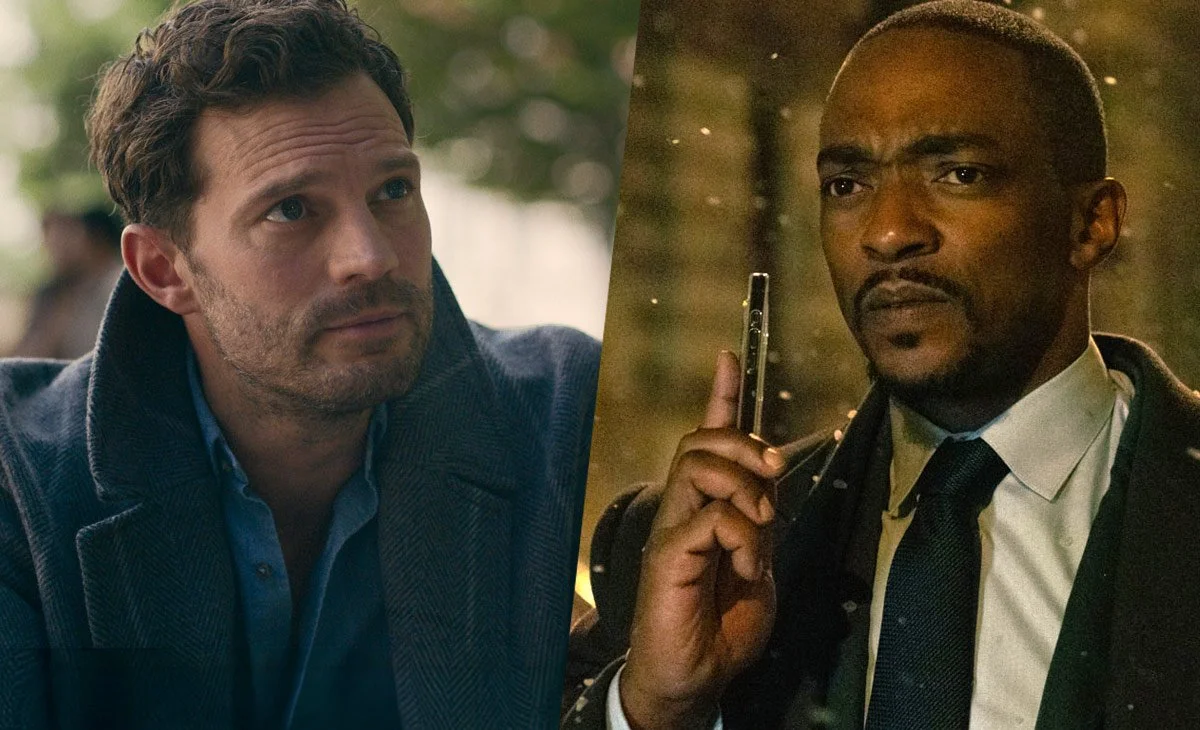
As Anthony Mackie closes in and the Alpine landscape becomes another formidable obstacle, the Apple TV thriller finds its greatest danger in the shifting loyalties of its own characters.
There is a difference between planning the perfect crime and assembling the perfect team. By its third episode, 12 12 12 is making that distinction increasingly difficult to ignore. Jamie Dornan’s Paul Galvin may understand the mathematics, mechanics, and extraordinary preparation required to execute an ambitious international robbery, but accounting for the unpredictable decisions of the people around him is another challenge entirely.
Titled “Einfach Obergeil,” Episode 3 pushes the Apple TV thriller deeper into the consequences of its central operation, with competing loyalties, mounting pressure, and an unforgiving winter landscape creating an atmosphere in which even the smallest disagreement can become a serious liability. Anthony Mackie’s FBI agent Jack Strickland remains determined to close the distance between himself and Paul, while the people involved in the robbery confront the increasingly uncomfortable reality that their greatest obstacle may not be law enforcement.
The series’ three-timeline structure remains central to the storytelling, moving between the preparation of the robbery, its execution, and the dangerous period that follows. This chapter revisits the development of the operation in March, offering a broader understanding of the decisions, relationships, and specialized knowledge required to bring such an audacious undertaking within reach.
As those preparations become more elaborate, the series continues exploring the fascinating relationship between criminal ambition and logistical precision. The money may be the ultimate objective, but getting to it requires a sophisticated understanding of geography, transportation, institutional routines, and the vulnerabilities that exist within otherwise formidable security systems.
What makes these sequences engaging is the realization that the most important elements of a successful operation are not always the most obvious. A seemingly minor maneuver can have consequences far beyond its immediate purpose, and an apparently straightforward assignment may conceal a considerably more complicated objective. The writers continue to take advantage of the audience’s familiarity with the outcome of certain earlier developments, allowing subsequent scenes to explain how the various pieces were assembled.
Yet the more carefully the robbery is constructed, the more precarious the relationships among its participants become.
Nowhere is that instability more apparent than in the relationship between Paul and his older brother Bobby Galvin, played by Jack Kesy. Their complicated history has already established a pattern of loyalty, resentment, and questionable judgment. Episode 3 pushes those tensions further, placing Bobby’s temperament alongside Paul’s need for discipline and control.
Kesy’s portrayal makes Bobby a disruptive presence within a narrative otherwise devoted to precision. His character operates with a different understanding of risk and responsibility, creating a recurring source of tension that Paul cannot simply solve through careful planning. There is something compelling about watching a strategist confront a problem that cannot be addressed by another diagram, calculation, or contingency.
The supporting characters become especially important as those disagreements intensify. Kira, played by Kali Reis, brings her own capabilities and perspective to the operation, while Séverine’s circumstances continue to complicate Paul’s attempts to separate his responsibilities to the crew from his obligations to the people he loves.
Agathe Rousselle gives Séverine an emotional presence that helps prevent the series from treating its criminal enterprise as an elaborate game without meaningful consequences. Her relationship with Paul is not simply a romantic subplot designed to humanize him. It is increasingly central to understanding why certain decisions carry weight beyond the immediate success or failure of the operation.
The episode also makes striking use of its Alpine setting. Where Zurich’s financial architecture and underground passages previously supplied much of the atmosphere, the snow-covered mountains introduce a very different sense of vulnerability. The landscape is expansive and visually imposing, yet the circumstances confronting the characters make it feel increasingly restrictive.
The resulting contrast is effective. A group capable of coordinating an extraordinarily complicated robbery can still find itself at the mercy of conditions beyond anyone’s control. Wealth offers little immediate comfort when mobility is limited, patience is running short, and the people expected to work together begin questioning one another.
Meanwhile, Mackie’s Jack Strickland continues approaching the investigation with the intensity of a man for whom professional success has become inseparable from personal vindication. His persistence remains a formidable threat, but the series is also interested in whether his determination represents an advantage or a vulnerability.
That question becomes especially relevant through his working relationship with Lena, played by Sallie Harmsen. Their contrasting personalities provide an engaging counterweight to the tensions developing within Paul’s crew. Where Jack is often instinctive, confrontational, and driven by his conviction that he understands the people he is pursuing, Lena brings a perspective informed by her knowledge of the environment and the institutional systems surrounding the investigation.
Their exchanges also give the production opportunities to balance mounting suspense with the sharp, occasionally irreverent dialogue that distinguished the premiere.
What emerges across the episode is a more complicated portrait of loyalty. The characters may share immediate objectives, but that does not mean they agree about the acceptable cost of achieving them. Personal history, financial interests, emotional commitments, and individual survival instincts all compete for influence.
This is where 12 12 12 becomes more than an exercise in elaborate criminal engineering.
The premise invites viewers to admire the audacity of the robbery, but the developing relationships ask a more difficult question: What happens when the people entrusted with executing a carefully designed plan begin making decisions according to their own fears and desires?
The series does not need to abandon its action or intricate plotting to explore that conflict. Instead, its most engaging developments demonstrate how personal behavior can undermine even the most sophisticated operation. The tension comes from watching the distance between what should happen and what human nature makes possible.
By its third installment, 12 12 12 has expanded beyond the immediate spectacle of a major bank robbery into an examination of trust under extraordinary pressure. The preparation remains fascinating, the pursuit grows increasingly urgent, and the ensemble continues revealing how difficult it is to maintain control once every participant has something different to lose.
For viewers drawn to the series by the promise of an elaborate heist, “Einfach Obergeil” offers another compelling chapter in the unfolding operation. But its most interesting development is the growing recognition that precision alone cannot guarantee success.
Paul Galvin can account for security systems, transportation routes, and almost every conceivable obstacle standing between his crew and an enormous fortune. The one variable he may never fully control is human nature.