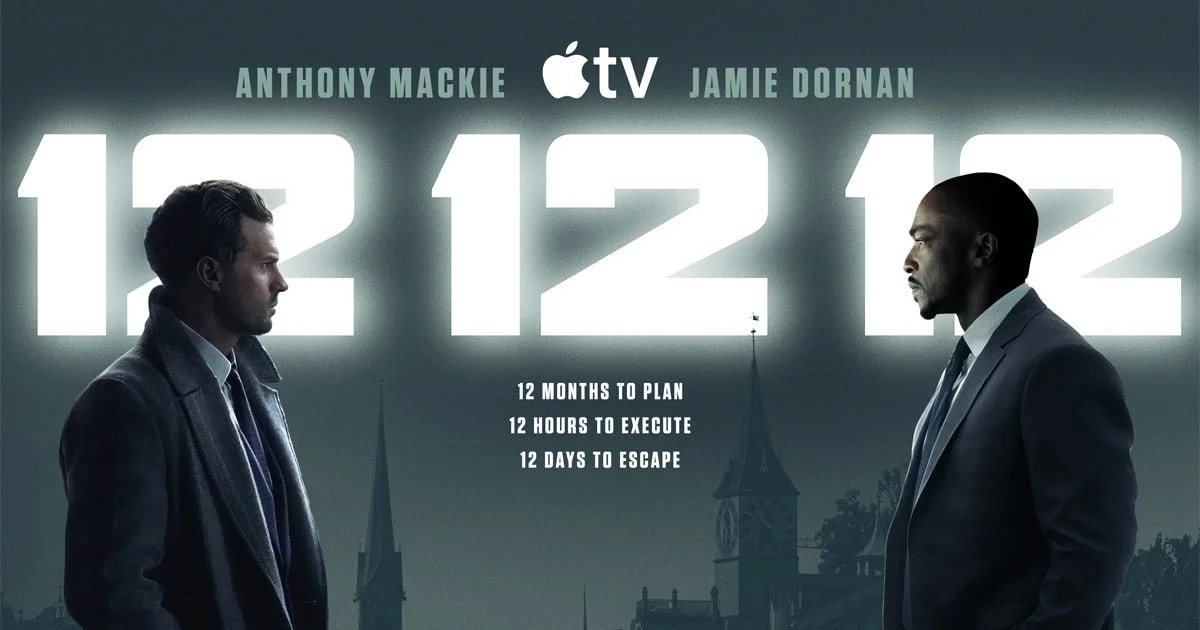
Jamie Dornan and Anthony Mackie anchor a sharply constructed crime thriller that wastes little time establishing its rules before finding increasingly inventive ways to challenge them.
Twelve months to plan. Twelve hours to execute. Twelve days to disappear. That is the premise behind 12 12 12, an eight-episode crime thriller starring Jamie Dornan and Anthony Mackie that arrives with the confidence of a series that knows exactly how it wants to command your attention. Within its opening minutes, the rules are established, the stakes are introduced, and the audience is invited into a world where meticulous preparation can mean the difference between unimaginable wealth and absolute disaster.
And what an invitation it is.
Set against the historic architecture, financial institutions, and picturesque winter landscape of Zurich, Switzerland, 12 12 12 takes the familiar ingredients of a heist thriller and rearranges them into something considerably more ambitious than a conventional robbery narrative. Its premiere is an exercise in carefully orchestrated suspense, weaving together multiple timelines while introducing an ensemble of characters whose personal histories are every bit as complicated as the operation at the center of the story.
Dornan stars as Paul Galvin, a gifted criminal whose understanding of risk, precision, and human behavior makes him particularly suited to a world where a single miscalculation can unravel months of preparation. Yet the series is careful not to define Paul exclusively by his criminal abilities. Beneath his calculated exterior lies a man wrestling with questions of family, responsibility, loyalty, and whether the circumstances of one’s upbringing must dictate the direction of one’s future. Dornan approaches those competing instincts with a performance that allows vulnerability and calculation to exist within the same character.
Opposite him, Mackie brings formidable presence and a welcome sense of humor to Jack, an American FBI agent whose determination to see an investigation through is matched by a personality that frequently puts him at odds with the people around him. Mackie is particularly effective when the series allows Jack’s intelligence and frustration to collide, delivering moments of biting dialogue without sacrificing the seriousness of his work. He is observant, stubborn, occasionally exasperating, and entirely unwilling to accept an explanation simply because everyone else has grown comfortable with it.
Although Dornan and Mackie occupy opposing sides of the law, the premiere finds interesting common ground in the emotional weight each man carries. Their circumstances differ, but both are navigating professional and personal consequences that complicate the choices before them. That underlying tension gives the series something more substantial to explore than the mechanics of a sophisticated robbery.
The supporting ensemble is equally important to the premiere’s momentum. Relationships between siblings, romantic partners, trusted confidants, and professional colleagues introduce competing loyalties and shifting expectations. Some exchanges are intimate and unexpectedly moving, while others are uncomfortable, confrontational, or darkly funny. These quieter moments are not distractions from the central story. They provide the emotional foundation that makes its larger developments matter.
Perhaps the premiere’s greatest strength is its approach to time. Rather than following a straightforward chronological progression, 12 12 12 moves between the preparation, execution, and consequences of a major criminal undertaking. Each narrative strand offers a different perspective, with information emerging at carefully selected moments. The series makes its central framework clear from the beginning, a refreshing decision in a television landscape where even the simplest premise can sometimes be withheld for the sake of an unnecessary mystery.
Here, the intrigue comes not from deciphering the title, but from understanding the people operating within its boundaries.
That distinction makes the storytelling especially satisfying. Scenes that initially appear disconnected begin to acquire greater significance as the narrative develops, while seemingly ordinary conversations take on additional weight. The writing rewards attention without making the viewing experience feel like homework. There is pleasure in recognizing a detail, recalling an earlier exchange, or realizing that a small observation may carry much greater importance than first imagined.
Visually, the series makes excellent use of its European setting. Zurich’s imposing financial architecture, historic religious spaces, underground infrastructure, and snow-covered streets create an environment where centuries of tradition coexist with contemporary systems of surveillance, security, and international finance. The contrast is compelling, particularly in a story concerned with money, ownership, secrecy, and the lengths people will go to obtain or protect what they believe belongs to them.
The action is another considerable strength. Rather than relying exclusively on spectacle, the premiere builds suspense through geography, movement, confined spaces, and the careful coordination of multiple characters. Its most effective sequences place viewers in situations where the physical environment becomes as important as the individuals navigating it. The result is an increasingly tense experience that manages to feel expansive and claustrophobic, sometimes within the same sequence.
Just as importantly, 12 12 12 understands the value of humor. The dialogue can be wonderfully irreverent, particularly when professional frustrations, cultural differences, and clashing personalities intersect. These moments give the audience room to enjoy the characters as people rather than simply as participants in a complicated criminal operation. The humor feels integrated into the storytelling instead of arriving as an obligatory interruption.
There are also intriguing questions beneath the surface. The premiere introduces ideas about generational influence, institutional power, the origins of wealth, and the complicated relationship between loyalty and obligation. It does not attempt to resolve every question immediately, nor does it need to. The most engaging stories understand that revealing a character’s circumstances is not the same as revealing everything that motivates them.
By the time the opening episode reaches its final stretch, the series has established an impressive command of momentum. Its shifting narrative structure, carefully developed character relationships, and escalating suspense combine to create the kind of television experience that makes reaching for the next episode feel less like a decision than an inevitability.
For viewers who appreciate intelligent crime thrillers, intricate heists, sharp dialogue, and performances that give the action genuine emotional stakes, 12 12 12 offers a compelling introduction to a world where planning is everything, certainty is dangerous, and the clock is never merely keeping time.
The rules may be simple. Playing by them is another matter entirely.