JAŸ-Z IN 8 Finale: Beyond the Music, Shawn Carter Confronts the Meaning of Power, Family and Legacy
As JAŸ-Z IN 8 prepares to conclude Friday, October 9, the conversation between JAŸ-Z and Rick Rubin arrives at its most expansive and personal territory yet. Across the final two chapters of the HBO original series, the music remains the foundation, but the questions become larger. What does loyalty mean when relationships change? How does success alter the way someone understands family, responsibility and power? And what happens when an artist returns to the words he wrote years ago with a perspective he did not possess when he first recorded them?
Six episodes in, JAŸ-Z IN 8 has established itself as something considerably more intimate than a traditional retrospective. The series has moved through childhood memories, the early years of hip-hop, the rise of Roc-A-Fella Records, friendship, loss, business and the complicated process of becoming Shawn Carter’s public alter ego. Chapters 7 and 8 push that format further, bringing together some of the most recognizable records in his catalog with conversations about betrayal, reconciliation, marriage, fatherhood, generational wealth and the emotional work required to understand one’s own history.
For viewers preparing to watch the finale, there are several moments worth listening for, particularly when familiar lyrics become the starting point for stories that extend far beyond the records themselves.
Chapter 7 begins by revisiting the early circulation of hip-hop mixtapes and the unlikely journey that brought a young JAŸ-Z into Big Daddy Kane’s orbit. Carter remembers a freestyle recording traveling along the Eastern Seaboard, introducing his voice to listeners who knew Kane and Jaz-O but were unfamiliar with the young rapper accompanying them. The attention eventually led to a working relationship with Kane and an opportunity to tour before JAŸ-Z had released a record of his own. He recalls studying Kane’s command of an audience, particularly his ability to move between songs without allowing a performance to lose its momentum.
The conversation expands into hip-hop’s regional evolution, including the emergence of N.W.A., Ice-T and the relationship between the production styles of Dr. Dre and Public Enemy’s Bomb Squad. Rubin and Carter consider how artists could draw inspiration from the same musical ideas while producing entirely different sounds, shaped in part by the cities and cultures surrounding them.
But one of the chapter’s most significant exchanges begins when Rubin asks whether JAŸ-Z has ever been misunderstood.
“Rap is misunderstood,” Carter observes, explaining that his position at the forefront of the genre has frequently placed his own work under the same scrutiny. He points to “Renegade” and its familiar challenge, “Do you fools listen to music or do you just skim through it?” as a question that remains relevant to how audiences interpret hip-hop.
The conversation also touches on “99 Problems,” with Carter arguing that listeners who focus on recognizable phrases without examining the full context can miss what a song is actually communicating. Rubin offers an interesting comparison involving Johnny Cash’s interpretation of “Bridge Over Troubled Water,” reflecting on how a different voice can reveal a story that listeners may have overlooked in a familiar recording.
It is precisely the kind of exchange that has made JAŸ-Z IN 8 compelling. The records have been available for years, but the opportunity to hear the thinking, circumstances and intentions behind them changes the listening experience.
Chapter 7 also explores some of the more difficult relationships in Carter’s life. Asked about betrayal, he recalls a frightening confrontation from his younger years involving a friend who fired three shots at him. What follows is not simply a recounting of the incident, but a broader conversation about entitlement, loyalty, communication and the choices people make when relationships deteriorate.
Those themes carry into his reflections on Kanye West, including the circumstances surrounding West’s “Big Brother,” a song that presented their relationship through the younger artist’s perspective. Carter offers his own understanding of the events referenced in the record, including a disagreement involving Coldplay’s Chris Martin. His larger point is that friendship does not confer ownership over another person’s relationships or creative opportunities.
“We don’t own people,” he tells Rubin.
The discussion moves through his history with Irv Gotti and eventually reaches the long-running rivalry with Nas. Carter revisits the early tensions surrounding Reasonable Doubt, the perceived lyrical exchanges that followed and the competition that eventually developed into one of hip-hop’s most discussed battles. Rather than simply revisiting the conflict, he considers what the rivalry demanded of both artists creatively and how their relationship evolved after the competition ended.
Elsewhere, the chapter provides a fascinating look at the creative decisions behind The Blueprint 3, including Carter’s original ambition to make an album informed by sounds and musicians from around the world. His reflections on how “Empire State of Mind” ultimately fulfilled that ambition offer an unexpected lesson in intention, creative instinct and the sometimes surprising paths through which an idea becomes successful.
The episode also turns toward therapy, emotional growth and marriage. Carter discusses how uncomfortable the idea of speaking openly to a stranger once seemed to someone raised to protect his personal business. He and Rubin explore what it means to surrender to a process that initially feels entirely contrary to the instincts developed through survival.
One of the lighter but equally revealing exchanges concerns Beyoncé’s recording process. Carter describes his wife’s willingness to experiment with vocal arrangements, melodies and layers of harmony, contrasting her approach with his own more direct method of recording verses. The discussion offers an unusual glimpse into two enormously influential artists whose creative instincts operate differently, even as both remain deeply committed to the possibilities of a song.
There are also memorable stories surrounding “Streets Is Watching,” “Hard Knock Life (Ghetto Anthem)” and “Empire State of Mind.” Carter recalls the moment he recognized the potential of the Annie sample that would transform his career, the skepticism he encountered about using it and his certainty that the record could connect with listeners far beyond hip-hop’s existing audience.
“I don’t have street credibility. I’m from the streets,” he remembers explaining when the record’s commercial potential raised concerns about his image.
That distinction becomes an important part of the chapter’s larger conversation about authenticity. For Carter, the challenge was not simply making a successful record. It was understanding how to create music with enormous reach without abandoning the experiences and perspective that made his work distinctive.
By the time the conversation turns toward the costs and benefits of fame, the idea of success has become considerably more complicated than record sales or recognition. Carter reflects on his family’s health, his grandmother and the value of having access to resources that can materially change the lives of people he loves. It is a perspective that gives the familiar story of his extraordinary financial success a more personal dimension.
Chapter 8 takes those questions of success, identity and responsibility into an even broader examination of what an artist leaves behind.
The concluding episode revisits “Empire State of Mind” from another perspective, including the darker realities beneath its celebration of New York. Carter discusses his interest in Gil Scott-Heron and the importance of acknowledging the people whose experiences do not necessarily resemble the triumphant narrative associated with the city. The exchange establishes an important tension that continues throughout the finale: ambition and achievement may be real, but so are the systems, circumstances and inequalities that complicate them.
“The Story of O.J.” becomes a particularly rich point of discussion. Carter revisits the influence of Nina Simone’s “Four Women” and explains his interest in examining race, identity, class and the assumption that extraordinary financial success can somehow separate a person from the larger social realities surrounding them.
The conversation moves into the song’s references to property ownership, credit, financial literacy and the differences between earning money and building lasting wealth. These are familiar subjects within Carter’s catalog, but the finale places them in the context of a larger question about who has access to opportunity, who controls resources and what happens when financial advancement is not accompanied by collective progress.
Rubin and Carter also revisit “No Church in the Wild,” examining the song’s questions about belief, morality, power and the contradictions of human behavior. Their discussion of historical imagery, religious institutions and the distinction between being a good person and making good decisions offers another example of how the series moves beyond the most frequently quoted lyrics to explore the ideas informing them.
The final chapter becomes especially personal with “Family Feud” and “Legacy,” two records from 4:44 that approach wealth and responsibility from perspectives shaped by marriage, fatherhood and the passage of time.
Through “Family Feud,” Carter discusses the importance of collaboration, collective economic power and the damage that can occur when communities compete internally rather than finding opportunities to build together. He also returns to his admiration for The Godfather, examining how his understanding of the film changed as he became more attentive to the emotional consequences of decisions he once viewed primarily through the lens of survival.
That evolving perspective is central to the conversation. A story that once seemed to be about strategy, power and staying one step ahead can look very different when viewed through the experiences of a spouse, a parent or someone responsible for the well-being of others.
“Legacy” brings the discussion even closer to home. Carter reflects on the meaning of generational wealth, the absence of inherited financial security in his own family and his desire to create a different starting point for his children. The conversation includes a touching memory of his mother, Gloria Carter, purchasing small savings bonds for him when he was young. Their monetary value was modest, but the intention behind them left a lasting impression.
For Carter, the significance was not simply the amount saved. It was that his mother was thinking about a future beyond the immediate financial demands of raising a family.
The episode also explores the relationship between generational trauma and the work of building something that can outlast one lifetime. Carter revisits difficult family history and considers how experiences once understood primarily through pain can eventually lead to a more complicated understanding of the people involved. These are among the finale’s most sensitive conversations, and they are best experienced as they unfold rather than reduced to isolated revelations.
That is ultimately what makes the final two chapters worth anticipating. Across eight episodes, Rubin has repeatedly returned Carter to the records, but the conversations have increasingly revealed the distance between the younger man who wrote them and the person interpreting them today. A song can preserve a particular moment in someone’s life, but it cannot prevent that person’s understanding of the moment from changing.
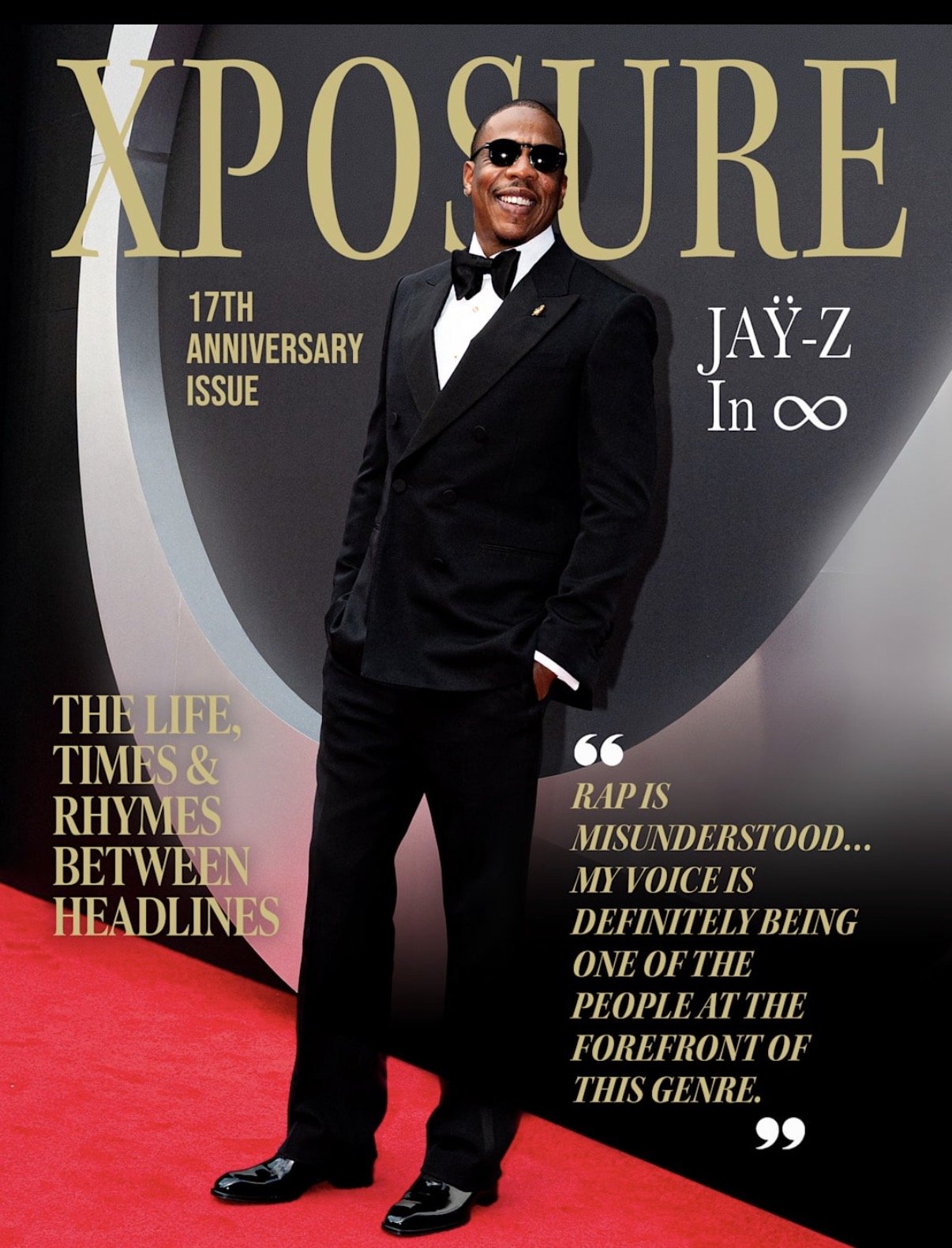
The finale also arrives at a particularly meaningful moment for Xposure Magazine. On October 7, we unveiled JAŸ-Z as the cover subject of our 17th anniversary Fall issue, featuring our forthcoming editorial, The Life, Times & Rhymes Between Headlines. The cover represents another chapter in our ongoing examination of the artist, his catalog and the cultural conversations that have surrounded his career for nearly three decades.
And the conversation will not end with Friday’s finale. JAŸ-Z is scheduled to return to the stage in Los Angeles for performances at SoFi Stadium on October 23 and 24, bringing the music examined throughout the documentary back into a live setting. After eight chapters devoted to understanding the stories behind the records, audiences will have another opportunity to experience the songs that have carried those stories around the world.
For Xposure, JAŸ-Z IN 8 has offered something particularly valuable: an opportunity to listen beyond the familiar headlines and consider how memory, experience and perspective continue to reshape the meaning of a body of work. The concluding chapters promise to bring that exploration full circle, returning to the questions of family, identity, responsibility and legacy that have been present in Carter’s music all along.
JAŸ-Z IN 8 concludes Friday, October 9, on HBO and HBO Max with Chapters 7 and 8. Xposure Magazine’s 17th anniversary Fall issue, featuring JAŸ-Z on the cover, is coming soon.
Xposure Magazine extends our sincere appreciation to our family at Warner Bros., HBO, Roc Nation, Mr. Shawn Carter and Mr. Rick Rubin for the opportunity to experience and cover this remarkable eight-part series. We look forward to continuing the conversation in our forthcoming Fall issue.