Netflix Walks Away From Warner Bros.: A Strategic Retreat That Speaks Louder Than a Takeover
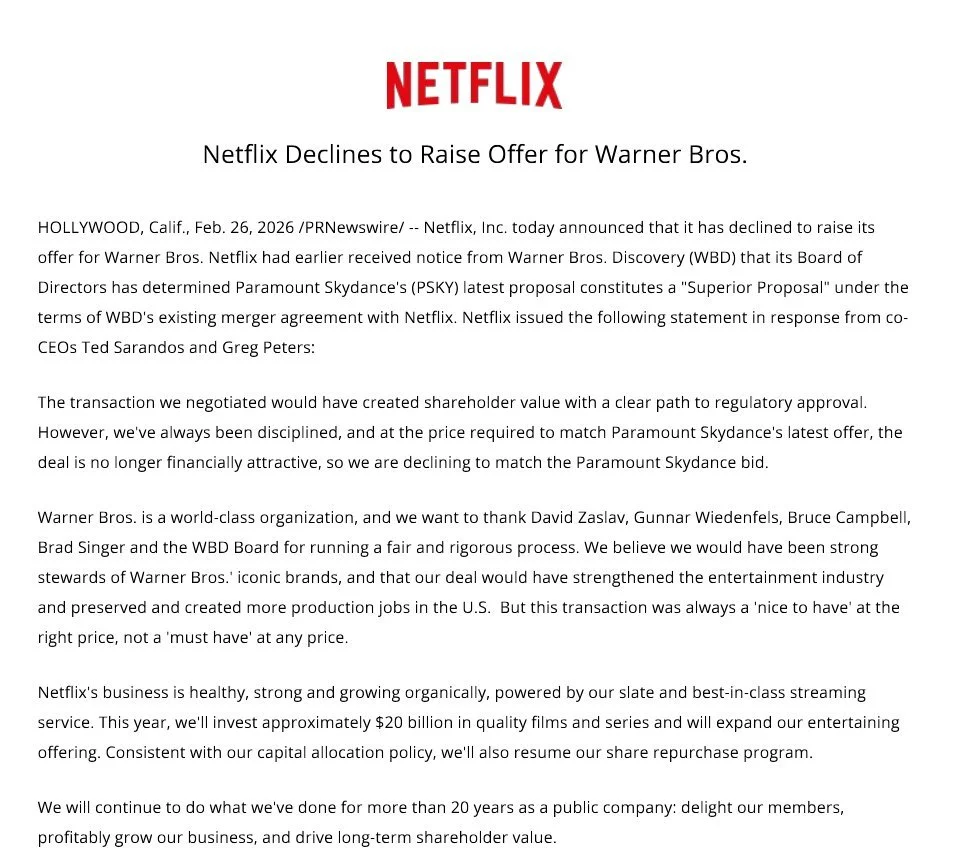
In a move that quietly reset the tone of Hollywood’s consolidation era, Netflix has officially walked away from a potential deal involving Warner Bros. Discovery. What once looked like a transformative power play has instead become a case study in corporate restraint — and perhaps, strategic clarity.
The decision not to pursue or escalate negotiations signals something deeper than a failed transaction. It reveals how the economics of streaming, regulatory realities, and shareholder expectations are reshaping the ambitions of even the industry’s most dominant player.
The Deal That Would Have Changed Everything
A Netflix acquisition of Warner Bros. Discovery would have fundamentally altered the media landscape. The combination would have brought together Netflix’s global streaming infrastructure with Warner’s legacy studio assets, franchise intellectual property, and premium television brands.
Warner Bros. controls one of the most valuable film and television libraries in the world. Its portfolio spans theatrical franchises, television production, news assets, and an established streaming platform. For Netflix, the deal would have accelerated vertical integration — giving it deeper control over production pipelines, theatrical windows, and long-term intellectual property ownership.
But that kind of scale comes at a cost. And that cost appears to have outweighed the upside.
Why Netflix Stepped Back
The decision to walk away was less about defeat and more about discipline.
First, financial structure matters. A transaction of this size would likely have required a mix of equity, debt, and long-term integration commitments. Investors have become increasingly sensitive to debt loads in media companies after several high-profile mergers created balance sheet strain rather than shareholder value.
Second, regulatory pressure is no longer theoretical. Large media consolidations now face intense scrutiny from federal and state regulators. Any deal combining a dominant global streamer with a historic studio and news division would have triggered months — if not years — of legal review. That kind of uncertainty freezes momentum and complicates operational planning.
Third, Netflix has historically thrived on agility. Its culture, cost structure, and decision-making processes are built around speed. Integrating a legacy studio with union contracts, theatrical distribution commitments, and traditional corporate hierarchies could have slowed the very engine that made Netflix dominant.
In walking away, Netflix appears to be protecting its identity as much as its balance sheet.
What This Means for Hollywood
This moment signals a pivot in the streaming wars.
For years, scale was the goal. Bigger libraries, bigger mergers, bigger headline valuations. But the industry has shifted from subscriber growth at any cost to profitability and efficiency.
Netflix’s retreat suggests that outright acquisition may not be the most strategic path forward. Instead, licensing, selective partnerships, and global expansion could deliver stronger returns with less structural risk.
It also leaves Warner Bros. Discovery in a critical position. The studio remains a prized asset, but its long-term path will depend on whether another buyer emerges or whether leadership focuses on internal restructuring and streaming stabilization.
Either outcome reshapes competitive dynamics across film, television, and direct-to-consumer platforms.
The Optics of Restraint
In business, walking away can be more powerful than winning.
For Netflix, declining to chase a higher price signals confidence in its current trajectory. It suggests leadership believes the company can continue growing — and competing — without absorbing the complexity of a legacy media giant.
It also reassures shareholders that management is prioritizing return on investment over symbolic dominance.
That matters in today’s market.
The Bigger Interpretation
The era of splashy megamergers in media may not be over — but it is being reconsidered. Investors now reward clarity, margin discipline, and sustainable growth more than empire building.
Netflix walking away from Warner Bros. does not signal weakness. It signals recalibration.
And in an industry where strategy often hides behind spectacle, restraint might be the boldest move of all.