Stevie Wonder’s Songs in the Key of Life at 50: The Masterpiece That Never Stopped Speaking to Us
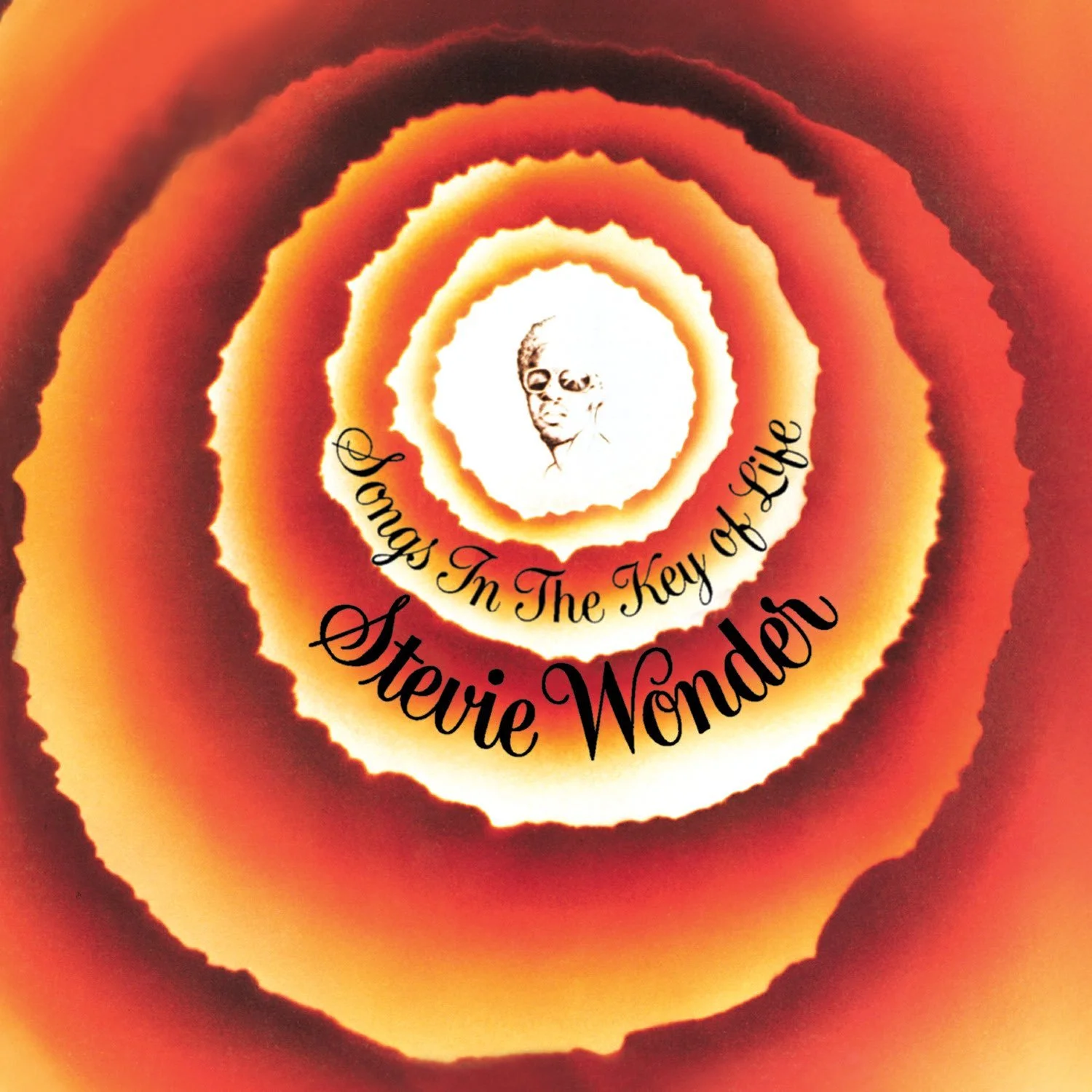
Released 50 years ago today, Stevie Wonder’s monumental Songs in the Key of Life did more than capture the sound of 1976. Across love, faith, Black life, childhood, inequality and joy, it created a musical language generations of artists are still speaking. Now Wonder is taking the complete album back to the stage for an international 50th anniversary celebration already producing sold-out dates.
Fifty years ago today, Stevie Wonder released an album with a title audacious enough to suggest that what waited inside could somehow encompass the breadth of human existence. Then he delivered.
Songs in the Key of Life, released September 28, 1976, was enormous in practically every sense. Issued as a double album accompanied by the four-song A Something’s Extra EP, its 21 songs stretched across nearly two hours and moved freely through soul, funk, jazz, pop, gospel, classical textures, Latin rhythms and sounds that resisted simple categorization. Wonder was only 26 years old, yet he approached the project with the perspective of an artist attempting to document not merely his own life, but life itself.
There are albums that survive because nostalgia keeps bringing listeners back. Songs in the Key of Life has survived because the world keeps catching up to it.
“Love’s in Need of Love Today” opens the album not with spectacle, but with a warning about hatred and the necessity of choosing love before it consumes us. “Village Ghetto Land” places images of poverty against elegant orchestration. “Black Man” insists upon a broader understanding of the people who built America. “Pastime Paradise” considers the danger of romanticizing a past that was never as perfect as memory makes it. Fifty years later, those records have lost remarkably little of their urgency.
And yet Wonder refused to make an album defined only by the problems of the world. Songs in the Key of Life is equally interested in the reasons that world remains worth living in.
“I Wish” turns childhood into irresistible funk. “Sir Duke,” inspired by Duke Ellington, celebrates the musicians whose work became immortal. “Knocks Me Off My Feet” captures romantic surrender without losing its tenderness. “Isn’t She Lovely” transforms the birth of Wonder’s daughter Aisha into one of popular music’s most enduring celebrations of parenthood. “If It’s Magic” asks what becomes of love if we fail to preserve it, while “As” stretches devotion toward something approaching infinity.
That range is the album’s miracle. Wonder could address structural inequality and then childhood. He could move from faith to romance, from grief to celebration, without any of it feeling contradictory because Songs in the Key of Life understood something fundamental: all of those experiences belong to the same life.
A Benchmark From the Beginning
The world did not need decades to recognize what Wonder had made. Songs in the Key of Life reached No. 1 in the United States and remained there for 14 weeks. At the 1977 Grammy Awards, it won Album of the Year, giving Wonder his third victory in that category in four years. He also won Producer of the Year, Non-Classical, for the project.
The accolades continued long after its original release. The Grammy Hall of Fame inducted the album in 2002, and in 2005 the Library of Congress selected it for the National Recording Registry, reserved for recordings considered culturally, historically or aesthetically significant to American life.
Those honors quantify something listeners already knew. The album did not simply contain great songs. It expanded the possibilities of what a popular album could contain.
Wonder built a universe large enough for synthesizers and strings, horns and harmonica, jazz musicianship and pop immediacy, social observation and deeply personal songwriting to coexist. The Library of Congress has noted the album’s influence across R&B, hip-hop, jazz and contemporary pop, including the musical paths subsequently traveled by Prince and Michael Jackson.
That lineage stretches much further.
Prince and Elton John have cited Songs in the Key of Life among their favorite albums. Michael Jackson and Whitney Houston praised it. Mary J. Blige and Luther Vandross interpreted Wonder’s compositions for new audiences. Kanye West once invoked Songs in the Key of Life, alongside Wonder’s Innervisions, as the kind of standard against which he wanted to measure his own work.
Then there is hip-hop, which found another life inside Wonder’s compositions.
“Pastime Paradise” became the musical foundation for Coolio’s generation-defining “Gangsta’s Paradise.” Will Smith built 1999’s “Wild Wild West” around “I Wish.” A Tribe Called Quest, 50 Cent and generations of producers and MCs have reached into Wonder’s work for sounds capable of carrying entirely new stories.
That is influence in its most meaningful form. The album did not remain sealed inside 1976. Its musical DNA continued moving.
Fifty Years Later, Back to the Stage
Perhaps the most extraordinary way to understand the durability of Songs in the Key of Life is not through an award, ranking or sales figure. It is through what is happening in 2026.
Wonder is celebrating the anniversary with the Songs in the Key of Life Performances – 50th Anniversary Tour, an 18-date international run through Europe, the United Kingdom, Ireland and the United States. Rather than reducing the album to a selection of recognizable singles, Wonder is scheduled to perform the landmark work in its entirety. The tour begins October 13 in Birmingham before eventually crossing the Atlantic for a U.S. run beginning November 19 at Madison Square Garden.
And audiences are responding accordingly. As of September 28, multiple dates are already sold out, including the November 3 performance at London’s O2, Manchester’s Co-op Live on November 8 and Glasgow’s OVO Hydro on November 11. Demand prompted an additional November 5 performance at The O2.
There is something beautiful about that demand.
These are not audiences gathering to commemorate an artifact whose relevance ended decades ago. Some people buying those tickets were alive when the album arrived. Others inherited it from parents and grandparents. Still others first encountered its melodies through samples, covers, movies, television, playlists or artists who were themselves shaped by Stevie Wonder.
That is how a record becomes larger than the era that produced it.
Wonder has performed the album in full before, including a 2013 benefit performance followed by the celebrated Songs in the Key of Life tour beginning in 2014. But performing it at 50 carries a different weight. This time, the distance itself is part of the story.
The child celebrated in “Isn’t She Lovely” grew up. The artists inspired by Wonder became legends themselves. Hip-hop sampled the album and created classics of its own. Entire genres evolved. Recording technology changed. Motown became history. The way we purchase, consume and discover music transformed almost beyond recognition.
The songs remained.
Still in the Key of Life
Perhaps that is ultimately why Songs in the Key of Life has endured.
Stevie Wonder never called it Songs in the Key of 1976. He chose life.
Life meant falling in love and watching children arrive. It meant remembering where you came from and imagining where you might go. It meant recognizing racism, poverty and injustice without surrendering your capacity for joy. It meant faith, disappointment, community, sensuality, history, heartbreak and celebration occupying the same space.
Fifty years later, humanity has changed considerably and not nearly enough. We still need love. We still wrestle with inequality. We still celebrate children, mourn people we lose, remember neighborhoods that shaped us, fall hopelessly in love, question the world around us and turn to music when ordinary language fails.
That is why Songs in the Key of Life does not sound like a museum piece celebrating its 50th birthday. Its influence can be heard across generations of R&B, pop and hip-hop, while its original songs continue filling rooms on their own terms. The Library of Congress once described the album’s significance as something that had only grown with time. Half a century after its release, that assessment feels less like historical praise than an observation still unfolding.
On September 28, 1976, Stevie Wonder gave the world Songs in the Key of Life.
Fifty years later, we are still living inside it.