Bob Mackie Made the World Sparkle: Remembering the Designer Who Turned Glamour Into an Art Form
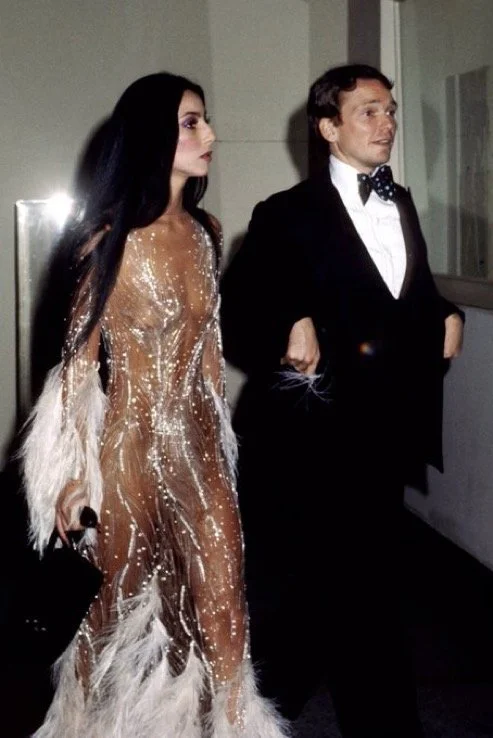
There are designers who make clothes, designers who make fashion and then there are those rare artists who help us understand what a star is supposed to look like.
Bob Mackie belonged to the latter.
For more than five decades, Mackie dressed some of the most recognizable performers in the world, creating clothes that didn’t merely accompany moments in popular culture. They became inseparable from them. Cher beneath a towering feathered headdress. Diana Ross shimmering under stage lights. Tina Turner commanding an arena. Elton John transforming a Dodgers uniform into rhinestone-covered spectacle. Carol Burnett descending a staircase wearing a curtain rod across her shoulders in one of television comedy’s most unforgettable visual jokes.
Mackie, who died September 14 at age 87, understood something fundamental about entertainment: sometimes the clothes have a job to do.
They can introduce a character before she speaks. They can make an audience laugh before the punchline arrives. They can turn a singer walking onto a stage into an event. They can transform vulnerability into confidence and excess into elegance. Most importantly, they can help a performer become larger than life without ever allowing the clothes to overwhelm the person wearing them.
That was the magic of Bob Mackie.
Before the Sequins, There Was the Sketch
Born Robert Gordon Mackie in Southern California, Mackie began his career in Hollywood as a sketch artist, working in the orbit of legendary costume designers including Edith Head and Jean Louis. His early years placed him inside a tradition in which costume design was not an accessory to filmmaking or television but an essential component of storytelling.
By the 1960s, his own visual language was emerging. Mitzi Gaynor enlisted Mackie to create costumes for her Las Vegas performances and television specials, combining three elements that would become central to his career: movement, glamour and entertainment. Soon afterward, Carol Burnett and producer Joe Hamilton hired him to design the wardrobe for The Carol Burnett Show. Mackie remained with the series throughout its 11-year run.
The partnership demonstrated his extraordinary range. Mackie could create breathtaking gowns worthy of Hollywood’s golden age and, with equal seriousness and craftsmanship, design something completely ridiculous because ridiculous was precisely what the scene required.
Perhaps nothing illustrates that better than Burnett’s famous Gone With the Wind parody. The costume, fashioned to look as though Burnett’s character had ripped down a curtain and turned it into a dress while leaving the curtain rod visibly attached, became one of television’s most celebrated costumes.
It was glamorous.
It was absurd.
And it was unmistakably Mackie.
Then There Was Cher
It is nearly impossible to tell the story of Bob Mackie without Cher, just as it is difficult to tell the visual story of Cher without Bob Mackie.
Their creative relationship began through television and ultimately stretched across decades, producing some of the most audacious images in entertainment history. Mackie understood Cher’s body, humor, confidence and willingness to take risks, while Cher possessed something equally valuable to a designer: the courage to actually wear the idea.
Together, they challenged conventional notions of what red-carpet and performance dressing could be.
Sheer fabrics, beads, feathers, sequins, exposed midriffs, towering headpieces and silhouettes that celebrated rather than concealed the body became part of a visual vocabulary that would repeatedly reappear in popular culture.
The famous feathered ensemble Cher wore to the 1986 Academy Awards was more than an outrageous outfit. It was fashion as defiance. Two years later, Mackie dressed her again when she attended the Oscars and won Best Actress for Moonstruck. Their collaborations would continue through concerts, television appearances and other landmark moments.
Following Mackie’s death, Cher imagined her longtime collaborator arriving in heaven equipped, appropriately enough, with sequins, beads and his sketch pad. It was a brief farewell that captured something essential about their relationship and the man himself.
He Didn’t Dress Stars. He Helped Create Their Visual Language.
Mackie’s client list reads like an archive of American entertainment.
Diana Ross. Tina Turner. Liza Minnelli. Ann-Margret. Barbra Streisand. Dolly Parton. Elton John. Carol Burnett. Cher.
Later generations would continue discovering him, wearing both new and archival Mackie creations. Beyoncé, Miley Cyrus, Pink, Madonna and other contemporary performers have carried his aesthetic into new eras, while stylists and younger artists have increasingly returned to his archives for a kind of glamour that refuses to disappear.
What connects those women and men is not that Mackie made them look alike. Quite the opposite. He understood character.
Tina Turner’s Mackie was not Cher’s Mackie. Diana Ross’s Mackie was not Carol Burnett’s Mackie. Elton John’s Mackie certainly wasn’t anyone else’s.
He designed for the person and the performance.
That distinction is why his work transcended the sometimes-dismissive label of “costume.” A Bob Mackie creation could reveal something about the performer wearing it: confidence, sexuality, humor, fantasy, extravagance, rebellion or sheer joy.
For Black performers in particular, that visual grandeur carried another dimension. Mackie’s work with artists including Diana Ross and Tina Turner presented Black women as spectacular, glamorous, sensual and commanding at a time when mainstream entertainment did not always offer them that visual freedom. Marilyn McCoo and Billy Davis Jr., whom Mackie dressed before their historic CBS television series, remembered that his designs represented more than fashion. They helped communicate presentation, confidence and possibility.
The Architecture Beneath the Sparkle
Calling Mackie the “Sultan of Sequins” was catchy, but it also risked obscuring just how technically accomplished his work was.
The sparkle was never accidental.
Underneath the rhinestones, feathers and beads was serious construction. These were garments frequently designed for performers who had to sing, dance, move under intense stage lighting and sometimes change costumes within minutes. A gown might need to appear impossibly delicate while surviving the physical demands of a live performance.
Elton John remembered that craftsmanship in his tribute to Mackie, noting not only the extraordinary vision behind his clothes but how beautifully they were made. For an artist who spent decades performing in some of the most elaborate stage costumes imaginable, that distinction mattered.
Mackie’s career eventually brought nine Emmy Awards, three Academy Award nominations and induction into the Television Academy Hall of Fame. In 2019, decades after he first began dressing Cher, he won the Tony Award for Best Costume Design of a Musical for The Cher Show. That same year, the Council of Fashion Designers of America honored him with its Geoffrey Beene Lifetime Achievement Award.
The recognition was overdue confirmation of something audiences had understood for years: costume design belongs within the larger history of fashion.
Look Around. Mackie Never Really Left.
Perhaps the clearest evidence of Bob Mackie’s influence is how contemporary his work still looks.
Today’s performance fashion is filled with ideas Mackie spent decades perfecting: the illusion dress, strategically placed crystals, second-skin bodysuits, dramatic feathers, barely-there fabrics, theatrical headpieces and costumes designed specifically for movement beneath stage lighting.
When today’s biggest performers walk onto stages wearing crystallized bodysuits or appear on red carpets in archival creations that blur the boundaries between nakedness and couture, they are participating in a visual conversation Mackie helped establish generations earlier.
The renewed fascination with archival fashion has only made his influence more obvious. Younger artists and stylists aren’t treating Mackie as a charming relic from another era. They are wearing him because the clothes still work.
That may be the greatest compliment fashion can give.
Glamour Was Never a Dirty Word
Fashion moves through cycles in which glamour becomes fashionable, unfashionable and fashionable again. Minimalism arrives. Maximalism returns. Hemlines rise, silhouettes change and entire aesthetics disappear only to reemerge decades later.
Bob Mackie never seemed particularly concerned with any of that.
He believed in glamour.
Not timid glamour. Not apologetic glamour. Not the kind that required pretending you hadn’t spent hours preparing to look extraordinary.
Mackie’s glamour announced itself when it entered the room.
There was wit in it, sexuality in it and sometimes camp, but there was also enormous respect for the transformative experience of getting dressed. He understood that clothes could give performers permission to occupy more space, command more attention and become, for a few minutes beneath the lights, almost superhuman.
That philosophy explains why his work traveled so successfully from one generation to another.
Bob Mackie didn’t simply dress stars. He understood why we look at them.
He understood the entrance, the reveal, the silhouette, the flash of light against a rhinestone and that split second when an audience collectively realizes it is witnessing something unforgettable.
The fashion world has lost one of its great architects of spectacle, but Bob Mackie’s work was never designed to quietly disappear.
It sparkled far too brightly for that.